
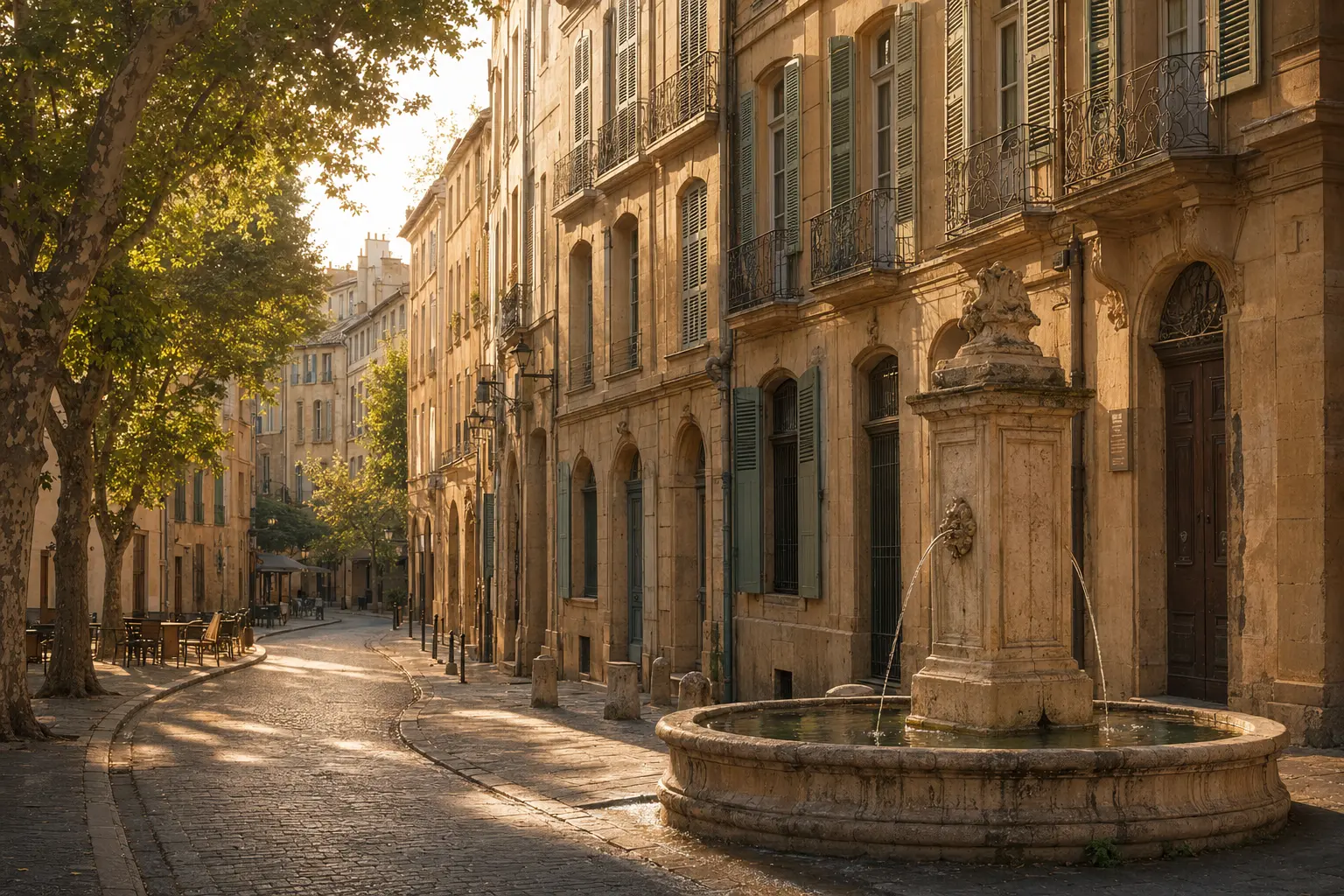
Original BestAix visual · illustrative, not documentary evidence
Car-free Provence
Aix-en-Provence,
beautifully without a car
The city is an excellent car-free base when the final address and excursions are chosen carefully.
Route logic
Central Aix is easier without a car
Pedestrian streets, markets and cultural sites reward walking; parking often creates more friction than freedom.
The limitation appears outside the centre: villas, vineyards, trailheads and some villages. Solve those as individual days instead of renting a car for the entire stay by default.
- Start with
- Place Richelme market
- Why start here
- Best morning
- Verify first
- Buy for the next meal and finish temperature-sensitive shopping before continuing.
Car-free Aix
The strongest experiences without driving
Central Aix is naturally car-free. Use public transport only for one deliberate extension rather than treating every remote estate as accessible.
-
01
Best morning
Place Richelme market
The most useful daily starting point in Aix: produce, local rhythm and an easy transition into the old town.
Route noteBuy for the next meal and finish temperature-sensitive shopping before continuing.
-
02
Best major collection
Musée Granet
The essential public museum for understanding the artistic depth of Aix, with collections spanning archaeology, European painting and modern art.
Route noteChoose either the permanent collection or the exhibition as the main visit if time is limited.
-
03
Best exhibition and garden
Hôtel de Caumont – Art Centre
The strongest choice when a major exhibition, 18th-century townhouse and elegant garden should form one polished visit.
Route noteTimed exhibitions can create queues; check the current programme and reserve when offered.
-
04
Best uphill cultural visit
Atelier de Cézanne
The most intimate Cézanne place: objects, light and working environment rather than a large collection of paintings.
Route noteReserve first, then use local bus or taxi if the climb would weaken the day.
-
05
Best evening anchor
Grand Théâtre de Provence
The principal large performance venue, especially useful for symphonic music, opera and major touring programmes.
Route noteBook the event first, then choose dinner by finish time rather than prestige.
-
06
Best bus-accessible modern art
Fondation Vasarely
The bold counterpoint to historic Aix: monumental optical works integrated into a purpose-built architectural centre.
Route noteCheck the current local route and final walk before departure.
For regional excursions, compare the exact outbound and final return on the official operator. “Near Aix” often still means a car-dependent address.
- 6 checked options
- Material review 23 July 2026
- By BestAix Editorial Team
- Access checked before departure
 01
01Arrival
Understand which station you mean
Aix TGV and Aix Centre are different places.
Aix-en-Provence TGV is outside the city and requires a shuttle, taxi or transfer. The coach station and Aix Centre rail station are close to the walkable core, but the final route may still involve cobbles and pedestrian streets.
Send the exact hotel address to any transfer provider and ask where the vehicle can legally stop.
- TGV
- Plan the last 15 kilometres before boarding the train.
- Centre
- Check luggage distance from the nearest vehicle drop-off.
 02
02Choose the base
Historic centre or Mazarin
Walkability should be treated as a hotel facility.
Old Aix suits market mornings and immediate restaurants; Mazarin gives elegant calm south of Cours Mirabeau. Both reduce daily transport demand.
A country hotel marketed as “Aix” can be excellent but undermine a car-free plan. Check actual walking routes and evening transport, not only kilometres.
- Best fit
- An address within an easy walk of the centre and coach station.
- Warning
- A beautiful rural property with no dependable evening return.
 03
03Selective excursions
Use the right tool for each day trip
Public transport, private transfer and organised tour solve different routes.
Marseille is naturally connected; Cassis and Luberon villages require more schedule discipline. For wine estates or Sainte-Victoire trailheads, a specialist guide may add both transport and context.
Check the return first. A route that works outbound may have an inconvenient final connection after dinner or sunset.
- Easy principle
- Choose destinations with a robust return, not only an attractive outward timetable.
- Private value
- Use a driver-guide when geography and expertise can share one cost.
Before following the route
Keep the day realistic
Small practical decisions protect the quality of the whole day.
- 01Cluster the day
Keep Old Aix, Mazarin and a major museum in a walkable sequence.
- 02Reserve the fixed point
Book the museum, guided visit or lunch that controls the timetable.
- 03Protect a pause
Heat and visual fatigue are real; schedule shade rather than hoping to find it.
- 04Check the live detail
Opening hours and access conditions belong to the official source for your date.
Route questions
The questions travellers actually ask
Direct answers, with changing conditions separated from durable advice.
Can you visit Aix-en-Provence without a car?
Yes. The centre is highly walkable and works particularly well for a short city break. A car is only necessary for certain rural stays, vineyards, trailheads and flexible village touring.
How do I get from Aix TGV to the centre?
Shuttle coaches, taxis and transfers connect the out-of-centre TGV station with Aix. Check current times and the final hotel drop-off before travel.
Where should I stay without a car?
Choose Old Aix, Mazarin or an address close to Cours Mirabeau and the coach station. Confirm the actual walking route with luggage.
What day trips are possible without a car?
Marseille is straightforward. Other destinations including Cassis, Sainte-Victoire and Luberon villages are possible with current public transport, an organised excursion or a private transfer, but require route-specific planning.
Primary evidence
Checked, dated,
and open to scrutiny.
Material editorial review completed on . Opening conditions, transport, access and commercial information can change; confirm decisive details before travelling.
- Responsible editor
- Nicolas Belotti
- Selection method
- Decision-led, source checked
- Purpose
- Fewer, better travel decisions
- Boundary
- No paid rank or invented visit
